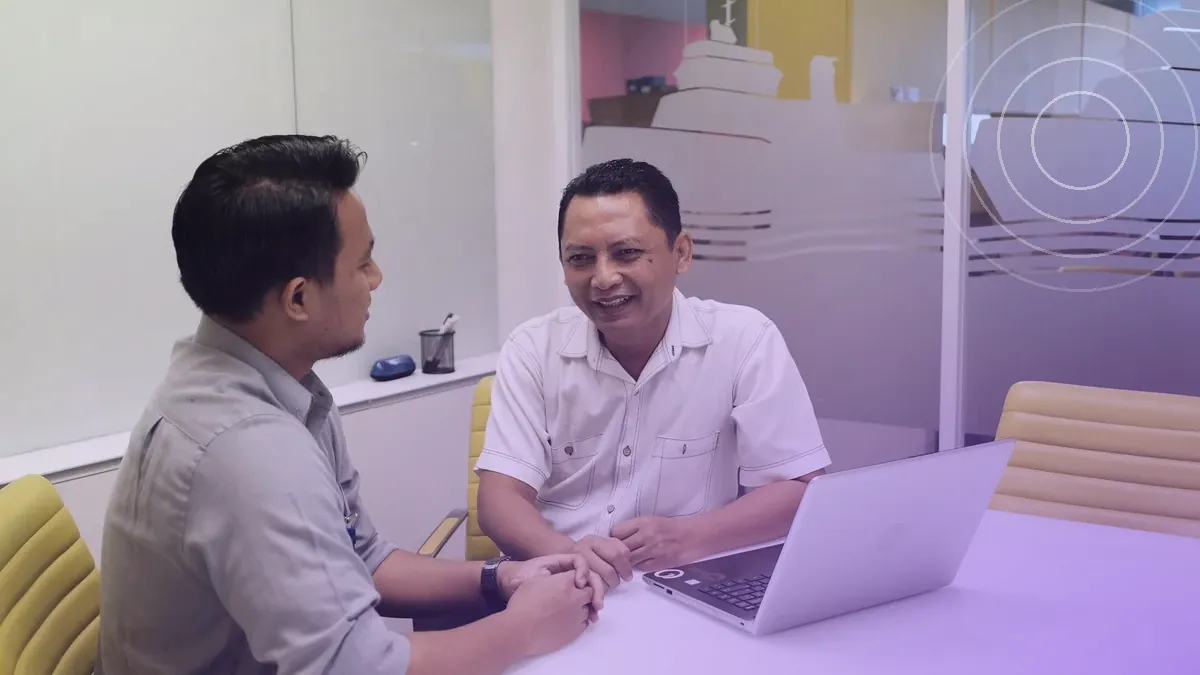
Job interviews in English: sample answers, key phrases, and a practice plan
An invitation to an English-language interview often makes candidates nervous, yet a perfect accent is rarely what is being assessed. Interviewers want to know whether you can explain your experience clearly, understand the questions, and communicate with a team. The good news is that these skills can be trained in a short time.
 Resmi.ID Team · 4 min read ·
 Photo: Windows / Unsplash
In this article, the sample answers are deliberately short and natural, followed by an explanation. Take the pattern, not the exact sentences, and fill it with your own experience.
Questions that almost always come up
"Tell me about yourself." Answer in 60–90 seconds: your current role, one achievement, then why you are applying. Example: "I'm a finance staff member with three years of experience in a distribution company. Last year I helped cut our month-end closing from seven days to four. I'm applying because I'd like to grow in financial analysis." Avoid starting with your birthplace or school history.
"Why do you want to work here?" Mention something specific about the company, then link it to yourself. Example: "Your company is expanding into eastern Indonesia, and I have experience setting up new branches. I'd like to bring that here."
"What is your biggest strength?" Choose one strength and back it with evidence. Example: "I'm good at explaining technical things simply. In my last role, I trained twelve new store staff on our cashier system."
"Do you have any questions for us?" Prepare two questions, for example: "What would success look like in the first three months?"
Answer structure: short and in order
For questions like "Tell me about a time when…", use the STAR method (Situation, Task, Action, Result), which we cover in a separate article. In English, the key is short sentences: one idea per sentence. Use sequence markers such as "First", "Then", and "As a result" so the interviewer can follow your story easily.
Phrases for clarifying and buying time
Asking for a question to be repeated is normal and sounds professional, and it is far better than answering the wrong thing.
- "Could you repeat the question, please?" — to hear the question again.
- "Just to make sure I understand, are you asking about…?" — to confirm what is meant.
- "That's a good question. Let me think for a moment." — to give yourself a pause.
- "Let me give you an example." — to move into a concrete story.
- "Sorry, let me rephrase that." — to fix a sentence midway through an answer.
Common mistakes by Indonesian speakers
- 1Direct translation"I very like this job" should be "I really like this job".
- 2Forgetting the past tenseFor past experience say "I managed", not "I manage".
- 3Wrong auxiliary verb"I am agree" should simply be "I agree".
- 4False friends"actually" means in fact, not at present (use "currently").
- 5Answers that run too longStop after the result instead of adding a new story.
- 6Too much self-deprecation"My English is bad, sorry" weakens your impression; just answer.
Watch "since" and "for" as well: "I have worked here for three years" (duration) and "since 2023" (starting point). Small slips like these are normal, but if they happen often they get in the way of clarity.
On nerves and accent
An Indonesian accent is not a problem as long as your words can be understood. Focus on three things: speak a little slower than usual, pronounce word endings clearly (for example "worked" and "tasks"), and pause between sentences.
Before the interview, take a few slow breaths and say your opening sentence out loud. A smooth first sentence usually makes the rest of the interview feel lighter.
A 1–2 week practice plan
- 1Days 1–2Write bullet-point answers to the five common questions above.
- 2Days 3–4Prepare three STAR stories from work or university experience.
- 3Days 5–7Record yourself answering, listen back, and fix tenses and pauses.
- 4Days 8–10Practise with a friend who asks random questions and interrupts.
- 5Days 11–14Run a full 30-minute mock interview, including your questions for them.
If you only have a few days, condense it into three steps: prepare your "Tell me about yourself" answer, one STAR story, and the clarifying phrases. For an online interview, also test your microphone so your voice comes through clearly.
If you suddenly get stuck
Anyone can lose a word mid-sentence. Do not panic, and do not suddenly switch to Indonesian. Describe it in other words, for example "the person who checks the stock" if you forget "inventory controller".
If you completely lose your way, say: "Sorry, I lost my train of thought. Let me start that again." Then sum up your answer in one or two sentences. Interviewers often pay attention to how well you recover.
Remember, your goal is not to sound like a native speaker but to show your value clearly. A few days of consistent preparation is enough to make a big difference.