Answering "Tell me about yourself" without sounding rehearsed
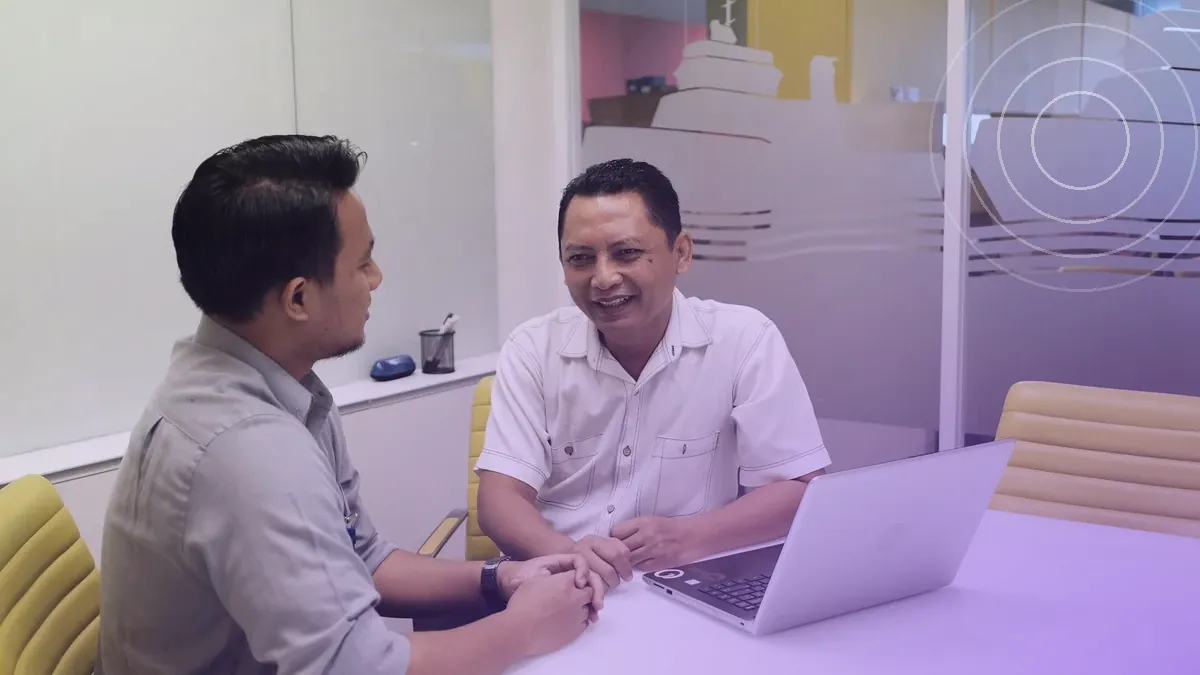
Almost every interview opens with "Tell me about yourself". It sounds casual, but your answer shapes the first impression and often sets the direction for the next questions. The interviewer wants to know who you are professionally, not your life story since primary school.
 Resmi.ID Team · 5 min read ·

What the interviewer really wants to know
- Whether your experience and skills fit this role.
- Whether you can explain something clearly and concisely.
- Why you're interested in this role and company, not just that you "need a job".
The present, past, future framework
- 1PresentState your current role and one or two key skills that are relevant.
- 2PastDescribe one or two experiences that built those skills, ideally with concrete results.
- 3FutureExplain why this role is a sensible next step and what you can contribute.
Aim for 60–90 seconds, roughly 150–200 spoken words. Shorter feels unprepared; longer makes the interviewer lose focus.
Sample answer: experienced applicant
"I currently work as a senior warehouse staff member at a food distribution company in Bekasi, mainly handling goods receiving and stock-taking. Before that I spent two years in dispatch, where I learned how important accurate stock data is. Last year I helped move our stock records from paper to a system, and our monthly stock discrepancies dropped considerably. Now I want to grow into a coordinating role, and this warehouse supervisor vacancy fits because your company is adding distribution centres."
Sample answer: fresh graduate
"I've just graduated with a D3 diploma in accounting from a polytechnic in Semarang. During my studies I did a three-month internship at a tax consultancy, helping compile invoices and prepare VAT reports for several small-business clients. In a campus organisation I was treasurer for an event with a budget of tens of millions of rupiah, so I'm used to recording expenses carefully. I'm applying for this accounting role because I want to deepen my bookkeeping skills at a growing company."
Sample answer: career changer
"For the past five years I've been a high school teacher, and the part I enjoyed most was designing lessons and training fellow teachers to use learning apps. This year I took a course in instructional design and built several online training modules for my school. That's why I'm interested in this employee training specialist role: I can bring my teaching experience along with my skills in creating digital materials."
Adapting to the interview situation
The same question can come up at different stages. In an initial HR interview, stress your general fit: experience, motivation, and readiness to work. With your prospective manager, give more weight to technical skills and examples of your work. If the interview is in English, use the same framework with shorter sentences so you don't trip up.
If the interviewer interrupts or asks a follow-up straight away, that's a good sign: they're interested. Follow their lead and don't force yourself to finish the whole answer you prepared. At the end, you can close with a bridging line such as "That's a short overview of me. If there's any part you'd like to explore further, I'm happy to explain."
Common mistakes
- Reading out your CV line by line.
- Going too far back, for example starting from your school days.
- Criticising your former office or manager as your reason for leaving.
- Saying "It's all in my CV"; this comes across as unprepared.
- Giving exactly the same answer to every company.
Practise without memorising
- 1Write points, not a scriptNote three to five keywords for each part of the framework.
- 2Say it out loudPractise a few times and record yourself on your phone to check timing and filler words.
- 3Tailor it to the companyRewrite the future part with reasons specific to the job you're applying for.
- 4Prepare follow-upsThink about questions your answer may prompt, such as details of a project you mention.
A good answer sounds like a conversation, not a speech. If you forget one part, that's fine; interviewers value an honest, well-ordered answer over a perfect sentence that sounds memorised.
If your interview invitation comes through KarirResmi, you can confirm attendance or request another time if it clashes, so you have enough time to practise.